
Tired of waiting for ECAT buses that never show up, only to learn the route has been changed without any notice on the website? Frustrated when calling ECAT for help and getting a disinterested employee who couldn’t care less about your question? You have a chance to be heard on Monday, April 13.
- Escambia County is hosting an open house from 5-6:30 p.m. on Monday, April 13, at the Brownsville Community Center, 3200 W. De Soto St., to gather input on the Escambia County Area Transit fixed-route redesign. The county administration says the aim is to “improve ECAT’s service, coverage and reliability. “
From the press release: The event will provide an opportunity for residents, ECAT riders, and stakeholders to engage with ECAT staff and project consultants, ask questions about the route redesign, and provide their input through interactive map displays and surveys. The public is also encouraged to provide feedback on the ECAT route redesign through an online survey and explore the interactive virtual room to learn more.
What is ECAT Fixed Route Service Redesign?
It’s billed as a complete overhaul of fixed routes. County states, “The project will look at how fixed-route buses, microtransit and paratransit services work together to better connect residents to jobs, education, healthcare, and other important destinations.”
- The limited public involvement stands in sharp contrast to the City of Pensacola’s approach to seeking input and engagement. In 2021, the county was much more proactive.
Five years ago, ECAT Built its 10-Year Transit Plan on Community Voice
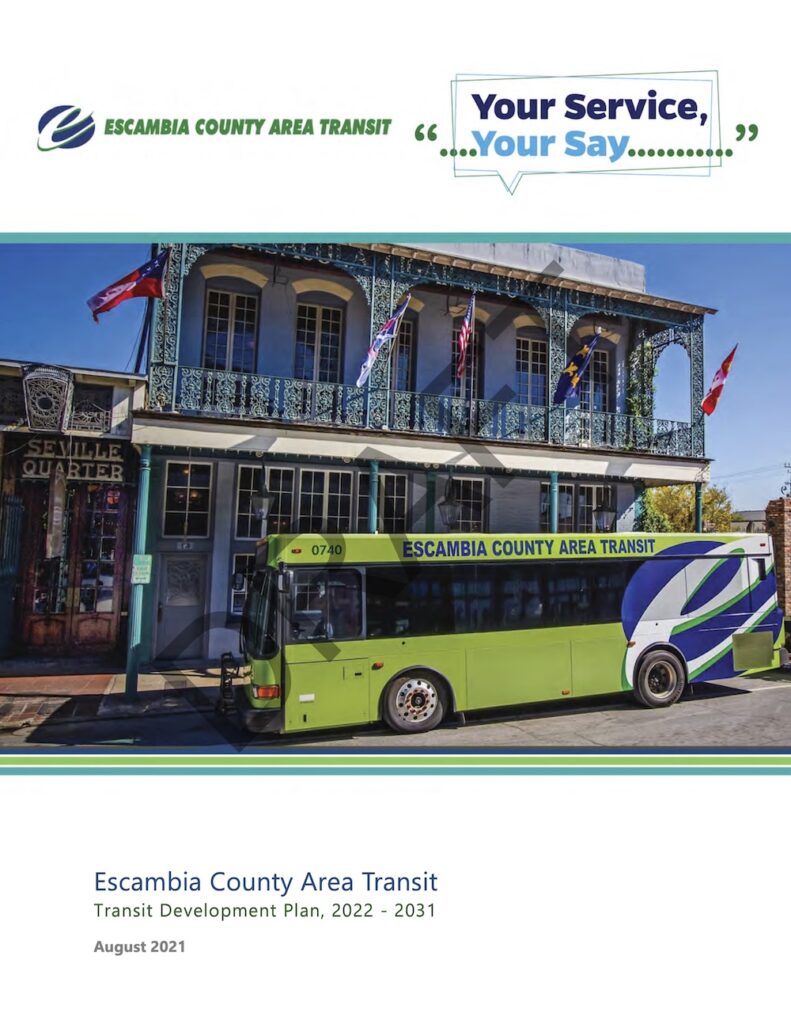
Escambia County Area Transit didn’t just hire consultants and draw lines on a map when developing its 2022-2031 Transit Development Plan. The agency went out and asked people what they actually needed.
- The public engagement process, branded “Your Service, Your Say,” unfolded in three phases between fall 2020 and spring 2021, gathering input from current riders, potential riders, community stakeholders and ECAT’s own bus operators. Despite the challenges of conducting outreach during a pandemic and in the aftermath of Hurricane Sally, the effort produced more than 1,100 survey responses and a clear picture of what Escambia County residents want from their transit system.
What Riders Said
The Phase I survey, focused on existing riders, drew 167 responses. The picture it painted was consistent with what transit advocates have long argued: ECAT primarily serves lower-income residents who depend on the system to get to work and shopping, with 85% of respondents reporting household incomes under $50,000 and half saying they have no access to a car, no license or no insurance.
- The most-used routes were 45, 52, 2 and 51 — the corridors connecting Rosa Parks Transfer Center and the Downtown Transfer Center to surrounding neighborhoods.
When asked to rate their experience, riders gave bus operators high marks. Hours of service, frequency and stop amenities were the weak spots. That feedback aligned directly with the improvements ultimately proposed in the plan.
The Broader Community Weighs In
Phase II expanded outreach to the general public, drawing 665 responses. Notably, 59% of those respondents said they don’t currently ride ECAT. Their reasons pointed squarely at the system’s structural limitations: no stop near their trip origin, buses that don’t run frequently enough and travel times that simply make transit impractical.
- When asked what single change would get them on the bus, 20% said more frequent service and 18% said service to new areas. Another 18% said nothing would change their minds — an honest reality check for any transit agency trying to grow ridership in a car-dependent region.
Asked about funding mechanisms, respondents showed the most appetite for a local gas tax increase (36%) and new developer fees (30%). And when asked to choose between improving the existing system or expanding to new areas, 59% said fix what you have first.
Stakeholders Speak Frankly
Perhaps the most candid feedback came from the discovery sessions — one-on-one virtual conversations with 15 community leaders, including Quint Studer, Visit Pensacola CEO Nicole Stacey, Greater Pensacola Chamber CEO Todd Thomson and representatives from Navy Federal Credit Union, Pensacola State College, UWF and the Downtown Improvement Board.
- The consensus was mixed but honest. Stakeholders acknowledged that the bus is widely perceived as a mode of transportation of last resort — for people who have no other choice. Buses were described as unreliable, routes as hard to understand and hours as too limited. But several stakeholders also recognized transit’s potential as an economic driver, particularly given Navy Federal’s traffic congestion challenges and the hospitality industry’s workforce needs.
Their wish list included later hours, more frequent service, a real-time tracking app, free Wi-Fi on buses and smaller vehicles on lower-demand routes. Several suggested partnerships with employers to subsidize passes — exactly the kind of model the plan’s financial section would later explore.
Prioritizing the Project List
The Phase III survey asked respondents to rank proposed improvements by importance. The results shaped the plan’s implementation timeline. Extending Sunday service to match Saturday drew the strongest support, with 48% rating it “very important” or “extremely important.” Saturday service matching weekday levels came in close behind at 56% combined.
Frequency improvements on specific routes also scored well, particularly Routes 52 and 2. Service to Navy Federal, perhaps counterintuitively, ranked last among the proposed projects — suggesting that while the concept has logic behind it, it hasn’t yet captured the public imagination the way expanded weekend and evening service has.
The Bottom Line
The “Your Service, Your Say” process gave ECAT something valuable: a community-endorsed argument for the improvements in this plan. When the agency goes to the Board of County Commissioners to request funding or to FDOT to seek grants, the survey data provides documented public demand rather than planners’ assumptions.
- The message from Escambia County residents was consistent across every phase: run the buses more often, keep them running later, and bring Sunday service up to Saturday levels. The plan that emerged reflects exactly those priorities.
Read the entire Transit Development Plan, 2022-2031.