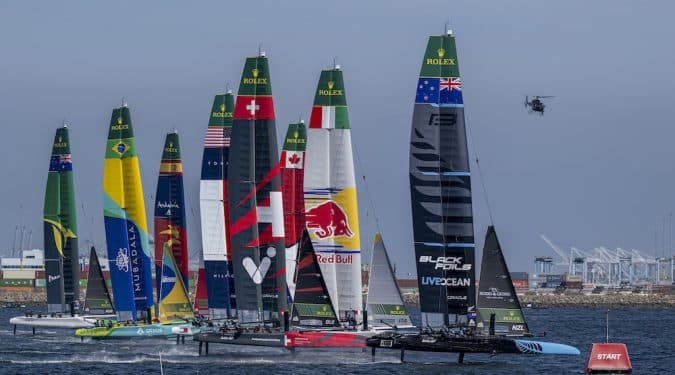
The New York Times’ Athletic writes that Pensacola could become the global hub for one of the fastest-growing leagues in professional sports. Read SailGP anchors in Pensacola.
- Background: SailGP, the international racing circuit featuring high-tech F50 foiling catamarans that fly above the water at speeds exceeding 60 mph, announced last month a six-year deal to establish its training base at the American Magic Performance & Innovation Center in Pensacola starting this September.
The Athletic’s Take: The facility was originally built for the American Magic campaign that competed in the last two editions of the America’s Cup. When American Magic withdrew from next year’s Cup in Naples, Italy, the future of the center was uncertain. Now it has a new mission — and one that could transform both the sport and the city’s growing reputation as a maritime hub.
Why this matters: The deal addresses what league officials and team bosses describe as SailGP’s most pressing problem: not enough time on the water. As the circuit has expanded to 13 teams racing at venues around the world, the logistics of constant travel have squeezed training opportunities to almost nothing. Phil Kennard, boss of the Canadian SailGP team, told The Athletic that his squad will get only four additional training days all season beyond Friday practice racing at events.
- “Our biggest problem is that the growing schedule of SailGP puts pressure on logistics and means that the days on the water are getting more and more squeezed,” Kennard said.
Details: SailGP managing director Andrew Thompson said the Pensacola base will have a dedicated F50 catamaran available for teams to rent starting this September, with a second boat slated to arrive by the third quarter of 2027. That second boat is when Kennard says the value “goes through the roof,” enabling two-team training sessions and competitive testing.
Training Waters
Thompson said the league is considering rules requiring teams to include younger development athletes in their Pensacola training programs — not just their first-team squads. The base could also offer a more affordable pathway into elite sailing for athletes from smaller nations who can’t fund expensive Olympic campaigns or the six-figure cost of competitive Moth dinghy racing.
- Future Growth: Perhaps most intriguing is Thompson’s hint at a “minor league” concept — smaller boats in the 25- to 30-foot range that could be permanently based in Pensacola, creating a feeder system for SailGP talent. He called the idea “embryonic” but said he could see it happening within a few years.
SailGP’s Season 6 is already underway, with 13 teams racing at venues from Perth to Dubai. Starting in September, the road to the podium will run through Pensacola.