Tomorrow morning, Escambia County’s Planning Board will consider the redevelopment for the county’s newest Community Redevelopment District, Myrtle Grove. The meeting starts at 8:30 a.m. at the Escambia County Central Office Complex, 3363 W. Park Place. Read Myrtle Grove Redevelopment Plan
Why Myrtle Grove
Nearly one in five homes in Myrtle Grove are in poor or dilapidated condition, with only 12.4% rated as good or excellent. The community’s 29 platted neighborhoods—with names like Elysian Fields, Royal Pines, and Weatherwood—face significant economic challenges, with median household income 26% below the county average at just $45,517.
- While Myrtle Grove represents only 2.65% of Escambia County’s population, it experiences disproportionately high rates of burglary, motor vehicle theft, and other property crimes. These conditions, combined with inadequate infrastructure and a shortage of affordable housing, prompted county leaders to formally declare the area blighted this past February—a necessary legal step to unlock powerful redevelopment tools.
Current Conditions
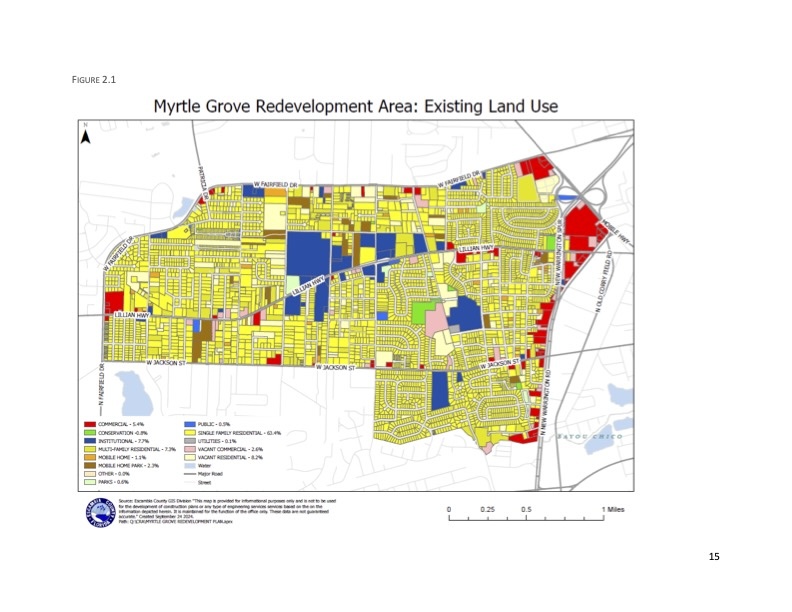
Current Land Use
Land Use and Housing: Myrtle Grove is overwhelmingly residential, with 82.3% of its 1,743 acres dedicated to housing. Single-family homes dominate at 63.4% of total land use, while 8.2% sits vacant and available for redevelopment. The area also contains significant institutional uses (7.7%), including Escambia High School, Myrtle Grove Elementary, and numerous churches.
Demographics and Economic Reality: With per capita income 28.6% lower than the county average, many residents fall into the “ALICE” category—Asset Limited, Income Constrained, Employed—meaning they work but struggle to afford basic necessities. Nearly half of households (45.6%) have only one vehicle, and 8.6% have none at all, limiting access to jobs and services.
Infrastructure Gaps: Critical infrastructure deficits plague the area. Only about half of Myrtle Grove has access to public sewer, forcing many residents to rely on aging septic systems. The sidewalk network is incomplete, particularly south of West Jackson Street, making walking dangerous or impossible in many areas. Stormwater management problems cause regular flooding in several neighborhoods.
A Vision for Transformation
The Myrtle Grove Redevelopment Plan establishes ten core objectives to guide the community’s evolution:
Physical Improvements
- Appearance: Upgrade visual quality of commercial corridors and residential neighborhoods
- Infrastructure: Modernize streets, sidewalks, lighting, drainage, and expand sewer service
- Congestion: Improve traffic flow while enhancing safety for all users
Community Building
- Citizen Involvement: Build lasting partnerships with residents and business owners
- Community Facilities: Expand programs for elderly and youth residents
Economic Development
- Reinvestment: Attract private investment in vacant and substandard properties
- Code Compliance: Ensure systematic enforcement of development and nuisance codes
- Zoning: Protect residential character while encouraging compatible commercial development
Strategic Implementation Approach
The plan takes a comprehensive approach to improvement, focusing on major corridors like West Fairfield Drive, Lillian Highway, and West Jackson Street. It taps into the “Reimagine Jackson Street” vision—a complete transformation of this vital east-west corridor featuring reduced speeds, mini-roundabouts, protected bike lanes, and underground utilities.
Neighborhood-Level Interventions: Recognizing that each of Myrtle Grove’s 29 neighborhoods has unique needs, the plan includes targeted strategies:
- Stormwater Solutions: Major drainage projects to address chronic flooding
- Connectivity: New sidewalks linking neighborhoods to schools, parks, and commercial areas
- Safety: Strategic streetlight installation and traffic calming measures
- Pride: Gateway signs and beautification projects to foster community identity
Commercial Revitalization: The plan identifies key commercial nodes for focused investment, particularly the blighted block bounded by New Warrington Spur, Lillian Highway, and New Warrington Road. Sewer extensions to commercial properties along major corridors will enable higher-quality development and attract new businesses.
The 30-Year Investment Plan
The redevelopment program envisions over $70 million in capital improvements funded through multiple sources:
Sidewalk Network ($4.8+ million) Priority projects include completing connections along North 57th Avenue, West Jackson Street, and major north-south corridors. These improvements will provide safe pedestrian access to schools, parks, and commercial areas while supporting the community’s “complete streets” vision.
Stormwater Management ($33+ million) Drawing from the county’s comprehensive Stormwater Advisory Team (SWAT) study, the plan prioritizes eight major drainage projects. Highlights include:
- $6 million for Royal Pines subdivision flood control
- $5 million for Elsa Area drainage improvements
- $4.5 million each for Bayou Marcus/Millview systems in multiple neighborhoods
Community Assets
- New Fire Station: $8.5 million to replace the inadequate Station #11 on Lillian Highway
- Library Branch: $7 million for a new facility, potentially at the former YMCA site
- Park Improvements: Enhancements to Meadowbrook Park II and Tulip Park
- Beautification: Gateway signs and landscaping throughout the district
Making It Happen: Implementation Framework
The Community Redevelopment Agency (CRA) will spearhead implementation, working closely with:
- Private Developers: Through commercial and residential improvement grants
- Housing Partners: Including the Neighborhood Enterprise Division for rehabilitation programs
- Infrastructure Agencies: Coordinating with ECUA for sewer expansion and FDOT for state road improvements
The plan leverages multiple funding streams:
- Tax Increment Financing (TIF): Captures increased property tax revenue from improvements
- Local Option Sales Tax (LOST): Voter-approved funds for major capital projects
- Federal/State Grants: Community Development Block Grants and housing programs
- Private Investment: Encouraged through public-private partnerships