
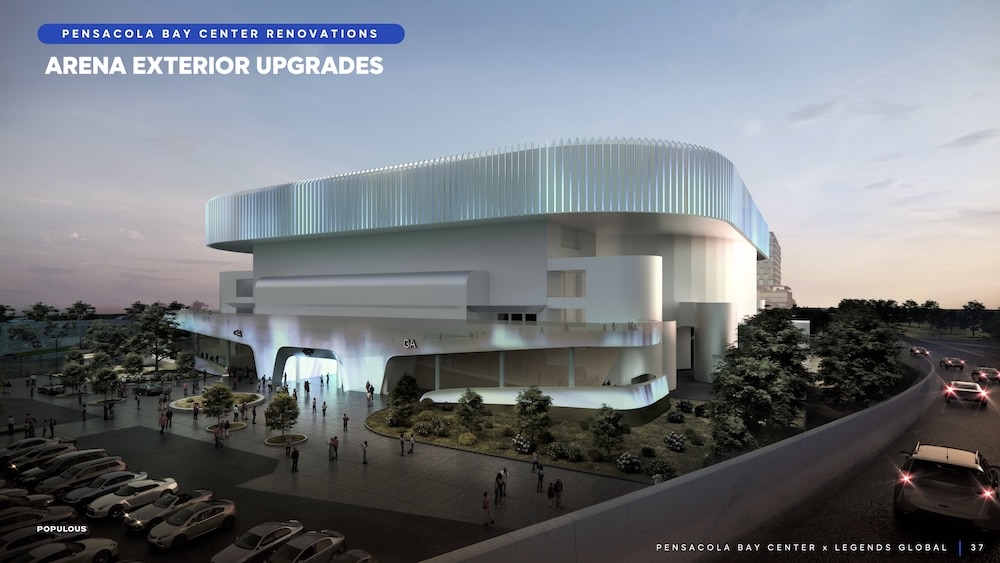
Armed with a new study calling for a convention center, Mayor D.C. Reeves wants to have a say in the renovations and expansion of the county-owned Pensacola Bay Center. Any additions—an indoor sports facility, ice rink, convention center or parking garage—will require a bond issue, as much as a $100 million-plus.
The Bluff
Reeves’ initial move has been to leverage the City’s sublease of the land at the exit of Interstate 110, which requires City approval for “a significant renovation or the construction of any new facilities on the site.” Read Civic Center, Lease.
- Dig Deeper: I spoke with County Attorney Alison Rogers about the lease. She sent the lease agreement to City Attorney Adam Cobb as a courtesy so the City would be aware that an approval would be sought as part of any bond issuance. She sounded surprised that Cobb and the mayor weaponized – my word, not hers – the lease to inject the City into the Board of County Commissioners’ decision about the Bay Center’s future.
The mayor’s letter to the Community Redevelopment Agency, which is comprised of the Pensacola City Council, pointed out that the City leased the property from the Florida Department of Transportation. He added, “Our operational sublease with the County makes it clear that City approval is required for either a significant renovation or the construction of any new facilities on the site.” Read DC Letter_CRA.
During his presser yesterday, I asked the mayor about the ominous statement, adding, “Some at the county might consider that a threat.”
Reeves: “Well, how so?”
“That you won’t approve, unless you like what they say.”
Reeves: “Of course not. I mean, ominous could be your term.”
Eye on the Prize
He continued, “You can editorialize ominous, I would say factual. But no, actually, if that leaves out the vast majority of the letter that says, ‘No, I think this needs to be done collaboratively.’ I think that should be our focus and keep our eyes on the prize. And as I clearly also say in that letter, ‘Hey, if we want this to be successful and we want this to happen anytime soon, we have to work together and not in silos’ is the other 97% of the letter is what that’s what it says.”
He stated that the statement was meant to let the City Council and Pensacola residents know “that from a legal standpoint, that we absolutely as city residents and city taxpayers have a say in what happens on the property.”
Reeves added, “No, we do not plan on waiting for the county to do something and then deciding yes or no. I certainly hope, unless you’ve heard some indication from the county that they don’t want to work collaboratively, I don’t think that’s a moot point. Hopefully, we continue to work collaboratively on this together. That’s why we’re having a joint meeting, and I think that’s what’s best if we’re representing our region, our county and our City.”
But What’s the Ante?
Mayor Reeves wouldn’t commit to how much money he would put into the Bay Center renovation and expansion, though he said, “There’s going to be a significant investment, and those are dollars that don’t exist in bed tax or anything else.”
He said, “I think we should be as imaginative as possible. And again, that’s why I think different tactics that are mentioned in this study, some might make sense, some may not make sense, but I think that’s the type of thinking that we need to do as a community, whatever needs to be involved.”
The mayor’s study lays out four scenarios in order of complexity and impact:
Scenario 1 — Traditional (Design-Bid-Build): Publicly developed, funded, and operated standalone convention center using bond funds and Tourist Development Tax dollars. Easiest to implement but lowest impact, with seasonal job creation and the same deferred maintenance risk the Bay Center already faces.
Scenario 2 — Hybrid Delivery: Public convention center paired with a privately developed and operated hotel on the Tech Park or Grand Hotel site. Significantly improves competitiveness, creates a walkable convention campus, and reduces public risk. Requires coordination but is more financially sustainable.
Scenario 3 — Public-Private Partnership (P3/DBFOM): Convention center plus hotel plus an entertainment district, using tax increment financing, land leases, and long-term concession agreements. Described as transformational, with significant job creation and placemaking impact. Most complex to execute.
Scenario 4 — P3 with Transit-Oriented Development (TOD): Scenario 3 plus integration of a mobility hub, trolley, bus routes, and potential use of the historic L&N Depot. Unlocks federal TIFIA financing and the broadest range of grant funding. The most ambitious and highest-value scenario, but also the most complex and longest to deliver.