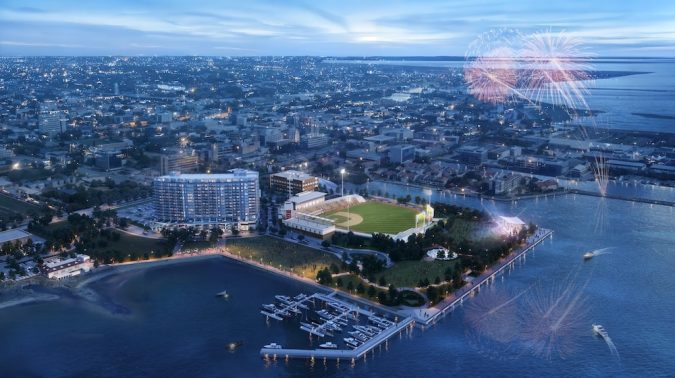
The numbers are staggering. A $280 million mixed-use development on Lot 5 at Community Maritime Park—247 residential units, a 147-key REVERB by Hard Rock hotel, a Michelin-star restaurant, 3,000 construction jobs, 300 permanent jobs and a 25,000-square-foot public plaza steps from Blue Wahoos Stadium. It would be the largest private investment in the history of downtown Pensacola, nearly double the $150 million Project Maeve at the Port.
- There’s just one catch. Without a 20-year Tax Increment Financing (TIF) rebate from the City’s Community Redevelopment Agency, none of it happens.
That’s not a negotiating tactic. It’s math.
The Rebate Program’s Purpose
The tax abatement being sought through this project is not a special favor or exception—it’s a publicly established incentive created by the City of Pensacola’s Community Redevelopment Agency (CRA) specifically to encourage exactly this type of development.
Background: The CRA’s Area Reinvestment Agreement for Affordable Housing (ARA-AH) program creates partnerships with private developers who can demonstrate a substantial public benefit to the community, including the creation of affordable housing, the elimination of blight and the strengthening of the local tax base.
“As a developer, applying for this incentive means meeting a rigorous set of criteria set forth by the City itself—criteria designed to ensure that any tax abatement awarded results in meaningful, lasting community impact,” said Dawson President and COO Tamara Bowens. “This is a transparent, public process governed by the City’s adopted community redevelopment plans, and the incentives available through the CRA are open to any developer willing to meet the established standards and deliver on those community goals.”
Inspired Communities of Florida (The Dawson Company) and Corporate Contractors Inc. submitted a TIF rebate application to the Pensacola CRA on February 26. The project—Rhythm Lofts and REVERB by Hard Rock on Lot 5 at Community Maritime Park—has been discussed since August 2024.
- The actual figure in the TIF application: the net annual ARA rebate requested is approximately $2.9 million—broken down as $1,049,089 on the rental units (after the Live Local exemption is applied) and $1,572,044 on the hotel keys, totaling roughly $2.9 million per year. However, after subtracting the $1.74 million the City will receive for the 49 condo units (see Dig Deeper below), the net rebate is $1.16 million annually. Note: The final numbers will change once actual construction costs and sale prices are determined.
Bowens and capital markets partner Nick Steen of Avison Young met quietly last week with the mayor and council member to explain what the rebate is, what it isn’t, and why the project can’t be built without it.
The Gap Between Viable and Not Viable
The core problem: Institutional lenders financing projects of this scale—Type I high-rise construction with reinforced concrete and steel—require a blended unlevered return on cost of roughly 8.1% to 8.6%. Without the TIF rebate, this project produces a blended return of about 5.4 percent. That gap doesn’t get filled by creative financing or sheer will.
- “We can’t meet our debt service coverage ratio and debt yield requirements from our lender without a tax abatement,” Steen told me. “It’s not that the lender was like, ‘Hey, you need a tax abatement.’ The lender was like, ‘If you don’t have a tax abatement, you guys have to go back to the drawing board.’“
That’s a remarkable statement on its own. The project’s primary financial backer is Diane Hendricks, co-founder of ABC Supply and founder/owner of Corporate Contractors Inc., one of the wealthiest self-made entrepreneurs in the country.
- She has provided a full personal guarantee for the loan. Four of the top ten U.S. banks by total reserves have issued term sheets. And still, those lenders are conditioning their commitments on TIF approval, because the project economics without it simply don’t clear their risk thresholds.
What the Rebate Actually Does
The application requests a 20-year, 100% abatement of property taxes on the 198 rental units and the 147 hotel keys.
- Dig Deeper: The 49 for-sale condominiums on the upper floors are excluded from the rebate entirely and will begin generating taxes immediately upon sale—estimated at roughly $1.74 million annually.
The gross annual tax increment the project would generate once complete is $5.6 million. After the TIF rebate and the Live Local Act exemption on the 99 middle-income units, the City nets $1.74 million per year from day one of stabilization. That’s compared to exactly zero dollars the vacant lot generates today—a lot that has sat empty for over a decade.
- “It’s an empty lot today that’s generating zero tax revenue,” Bowens said. “And you have someone (Diane Hendricks) who comes in and says, ‘Not only do I want to develop it, but I’m going to personally guarantee it.’”
Without the rebate: The most viable alternative for Lot 5 is a single-use, mid-rise hotel generating $1 to $1.25 million annually in taxes—with no affordable housing, no public plaza, no structured parking and none of the cultural amenities the CRA has been calling for on this site for years.
The Brownfield Reality
One factor that gets overlooked in the conversation about incentives is the site itself. Lot 5 sits on a former EPA brownfield—legacy creosote and PAH contamination from the old Frisco Docks rail and pier operations.
Before a single vertical beam goes up, the development team faces extraordinary environmental remediation costs: FDEP-certified segregation, testing, special handling, regulated disposal and ongoing monitoring.
- “We were in the hole from the beginning just because of the remediation work,” Bowens said. “People forget that it is a brownfield plot of land.”
Greenfield developments elsewhere don’t carry those costs. They’re unique to this site and they directly suppress the returns the project can generate—which is precisely the kind of circumstance that tax abatement tools were designed to address.
A 70% Abatement, Not 100%
One point worth clarifying from initial media coverage: because the 49 condos are excluded and will pay full property taxes, the effective abatement on the total project works out to roughly 70%—not 100%—when viewed against the complete tax picture.
- Comparable projects across Florida have received more. Jacksonville’s Four Seasons at the Shipyards got a 20-year, 75% TIF rebate with no affordable housing component and no public space requirement. Panama City has approved 90% rebates. Pensacola is being asked for less, in exchange for significantly more.
The ARA application now goes to the CRA board for a recommendation, with a city council vote expected sometime in May. Lot 5 has waited long enough. Read Pensacola CRA TIF Rebate Application





Why wasn’t tax relief addressed in their initial proposal.?
Good read.
A fair deal for taxpayers would be tax relief for all expenses relating to remediation of the polluted property. That’s it.