Hurricane Isaias
Still Waiting on the White House
Gov. Ron DeSantis asked President Donald Trump for a Major Disaster Declaration after Hurricane Isaias. Northwest Florida residents are still waiting for the signature that unlocks individual aid.
- Gov. Ron DeSantis announced on Oct. 16 that the Florida Division of Emergency Management had submitted a request to President Donald Trump for a Major Disaster Declaration following Hurricane Isaias. The request seeks Public Assistance for 15 counties and Individual Assistance for eligible residents in eight counties, including Escambia and Santa Rosa. As of this writing, the White House has not signed it.
What Has Been Approved, and What Hasn’t
Emergency declarations are not disaster declarations. Trump issued preliminary emergency declarations under the Stafford Act before and just after the storm. Those open the door to federal coordination and direct federal assistance. They do not authorize the individual financial assistance that homeowners and renters need to start rebuilding.
Both types of assistance require a presidential disaster declaration to move forward.
How the process works. Federal disaster assistance is generally activated when a governor requests a presidential declaration, and the president approves it under the Robert T. Stafford Disaster Relief and Emergency Assistance Act. Two main categories of help depend on that approval:
- Individual Assistance may provide aid to eligible individuals and households affected by a federally declared disaster, subject to program eligibility requirements. Damage documentation is an important first step in establishing the scope of the storm’s impact.
- Public Assistance may reimburse eligible costs for emergency response, debris removal and repairs to public infrastructure. Certain private nonprofit organizations may also qualify.
Until the declaration is signed, local governments cleaning up after Isaias cannot be certain Washington will reimburse them, and families cannot apply for FEMA help with temporary lodging and home repairs.
Much Faster After Other Hurricanes
Recent storms, under presidents of both parties, drew far quicker action:
- Hurricane Michael hit the Panhandle on Oct. 10, 2018. The Trump administration issued a federal disaster declaration the next day, Oct. 11.
- Hurricane Sally made landfall on Sept. 16, 2020. Alabama, which took a direct hit, got its declaration on Sept. 20, four days later. Florida’s came on Sept. 23, seven days after landfall and five days after DeSantis submitted the request.
- Hurricane Ian hit Southwest Florida on Sept. 28, 2022. The Biden administration issued a federal disaster declaration the next day, Sept. 29.
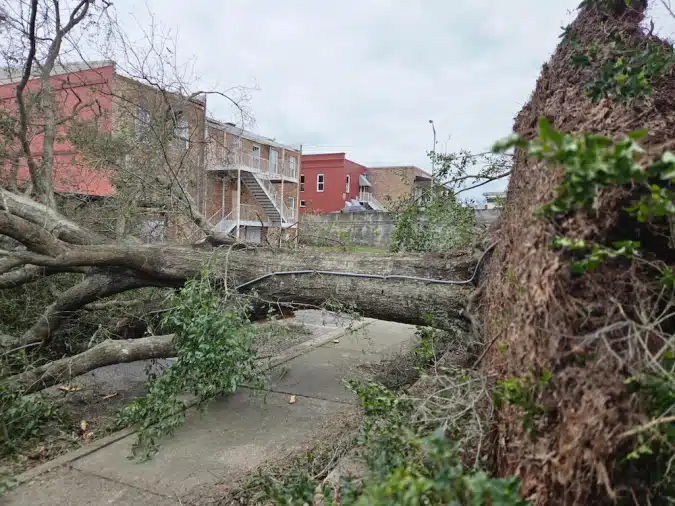
- Hurricane Isaias came ashore near Destin on Oct. 9, 2026, as a Category 2 storm. Nearly three weeks after landfall, there is still no signed major disaster declaration.
The numbers behind the storm. The state has reported six deaths blamed on Isaias, and more than 448,000 customers lost power at the peak. Insurers have received more than 41,000 homeowner claims.
It Is Not Just Isaias
An Associated Press analysis, published by PBS in July, found a pattern. Trump has taken longer on average to approve disaster requests than any other president, according to the AP’s review of FEMA data dating to 1989. Since taking office, Trump has taken an average of a month and a half to approve major disaster declarations after receiving a request.
- During his first term, the average was about three weeks, similar to Joe Biden’s pace. Obama, both Bushes and Clinton all averaged less than two weeks.
- Seventy percent of Trump’s second-term approvals have taken at least a month. That compares with about one-quarter in his first term and under Biden, and fewer than 10% under earlier presidents.
- He has approved about 80% of requests from Republican governors and about 60% from Democratic governors. More than three-fourths of requests from states that voted for him in 2024 were approved, compared with less than half from states that did not. Trump won Escambia with 59% of the vote. In Santa Rosa, he received 75% of the vote.
What Happens Next
Local officials have been working the phones. Sen. Rick Scott and Congressman Jimmy Patronis have sent letters to the administration stressing the need for the declaration, and Scott has said he was told Trump will approve it. DeSantis has said he expects a decision “very, very quickly.”
- Every day without a signature is a day of limbo. Homeowners with blue tarps on their roofs, renters who lost belongings and local governments carrying debris-removal bills all need to know whether federal help is coming. Michael, Sally and Ian showed it can be done in days. Isaias is on track to take weeks.