Hurricanes leave the same wreckage everywhere: downed lines, ruined roofs, streets buried in debris. What they take that never makes the damage estimates is harder to count.
- Poppy Tamberella spent 37 years working storm recovery from Texas to New York. This time the devastation was on her own street in Gulf Breeze. In this essay, shared with me by a close friend, Tamberella writes about the century-old oaks that are gone, the days without power, the neighbors who showed up with generators and cold drinks, and what it feels like to finally look at a disaster without a job to do.
It’s funny in places, and it’s heavy in others. Read it all the way through.
I have lived through more hurricanes than I care to count, and after 37 years of working storms, I thought I had seen just about everything Mother Nature could throw at us. But this one has left me with a feeling I can’t quite put into words.
Gulf Breeze will never look quite the same.
It’s not just the downed power lines, the damaged homes, the mountains of debris lining our streets, or the endless sounds of chainsaws, generators, and heavy equipment. It’s the trees. My God, the trees.
The beautiful old oaks that have stood watch over our neighborhoods for generations. The towering pines, the magnificent canopies that shaded our streets, the trees we drove past every single day without giving them a second thought. Some were older than the homes they surrounded. They were part of the character, the charm, and the very soul of this little community we call home.
And in a matter of hours, so many of them were gone.
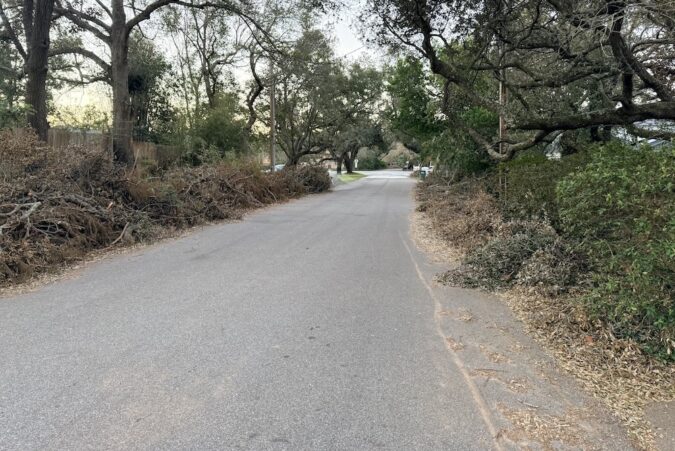
My own street was once a beautiful, tree-lined canopy of magnificent old oak trees. Their branches stretched across the road, meeting overhead and creating this incredible tunnel of green that made coming home feel like something special. The sunlight would filter through the leaves, casting shadows across the pavement, and even on the hottest Florida days, there was something comforting about driving beneath those enormous old trees. It was one of those things I loved about living here, something I probably took for granted because I thought it would always be there.
And now, so much of that beautiful canopy is gone. The sky is wide open where those branches once met. The familiar shade has disappeared, and the street I’ve traveled countless times in my life looks almost unrecognizable. I never imagined I could grieve the loss of trees quite like this, but I do. Those oaks weren’t just landscaping. They were part of our neighborhood’s history, part of its personality, and part of what made this little corner of Gulf Breeze so special. Some of those trees took a century or more to become what they were, and it took one terrible night to bring them down.
I think that’s what hurts the most. We can plant new trees, and we certainly will, but most of us will never live long enough to see that magnificent canopy return. And there is something profoundly sad about that.
Our gardens, our flower beds, the landscaping we spent years planting, nurturing, trimming, and occasionally cussing at when something refused to bloom. All those little pieces of ourselves that we put into making our homes beautiful. Some washed away, some buried beneath fallen trees, and others simply beaten beyond recognition.
I walked around my property looking at what used to be familiar, and for a moment, I felt like a stranger in my own yard. Places that were once shaded are now exposed to the sky. Views that were hidden behind beautiful greenery are suddenly wide open. There are empty spaces where something magnificent once stood, and I don’t think we realize just how much those trees meant to us until we’re looking at the places where they used to be.
There’s a certain sadness in that.
You can rebuild a fence. You can replace a roof. You can repair a pool, although mine may need divine intervention and a team of specialists at this point. But you cannot replace a hundred-year-old oak tree. Not in our lifetime.
And that is what breaks my heart the most.
Driving through Gulf Breeze now is almost surreal. Streets that were once tunnels of green are lined with broken limbs and piles of what used to be beautiful trees. Neighbors are standing in their yards surveying the damage, trying to figure out where on earth to begin. The landscape of our community has changed overnight, and I suspect it will take a long time before any of it feels normal again.
But there is something else I’ve noticed.
In between the chainsaws and the cleanup, there are neighbors helping neighbors. People sharing generators, offering cold drinks, checking on the elderly, clearing driveways, and lending a hand wherever one is needed. People who have their own mess to deal with are showing up to help someone else with theirs.
And that, my friends, is the Gulf Breeze I know and love.
We may have lost our beautiful tree-lined streets, but we certainly haven’t lost our sense of community.
And then there is the electricity. Something so simple, something we take for granted every single day until suddenly it isn’t there.
We lost power Friday and didn’t get it restored until last night. And I have to tell you, there is nothing quite like several days without electricity to make you realize just how spoiled we’ve become by the little conveniences of everyday life.
You walk into a room and flip the light switch. Nothing. Ten minutes later, you walk into the same room and flip the same switch again, apparently convinced that this time some electrical miracle has occurred. Never mind that the transformer is sitting in the damn street in front of your house. Apparently, after enough days without electricity, optimism and stupidity become remarkably difficult to distinguish.
But somewhere between the humor and the frustration, you begin to realize just how much we take for granted.
A hot shower. A cold glass of water. A refrigerator that keeps your food from spoiling. The ability to make a cup of coffee, wash a load of clothes, turn on a lamp, or simply sit in a quiet, air-conditioned room at the end of a long day.
All those ordinary little things that we never give a second thought.
And perhaps the one thing I missed most was the quiet. The kind of quiet you don’t even realize exists until it’s replaced by the constant rumble of generators, the screaming of chainsaws, and that incessant BEEP, BEEP, BEEP of trucks backing up. I swear that sound is going to follow me into my dreams for the next six months.
But there is something humbling about sitting in the dark, surrounded by the aftermath of a storm, realizing how quickly life can change. How dependent we’ve become on things we simply expect to work. How fortunate we are to have the comforts we do, and how rarely we stop to appreciate them.
And even in my frustration, I couldn’t help thinking about the people who had lost so much more than electricity. People who didn’t have a home to turn the lights back on in. People who were wondering where they would sleep, how they would rebuild, or what tomorrow would look like.
Suddenly, my inconvenience seemed very small.
As for the cleanup, I know we will get through it. The grass will grow, the flowers will bloom again, and little by little, our yards will begin to resemble something other than an abandoned lumberyard.
But I also know that the Gulf Breeze we wake up to tomorrow will look different from the one we knew last week.
And perhaps that’s what makes this so emotional. We don’t just become attached to our homes. We become attached to the surroundings, the familiar beauty, the shade, the gardens, and all the little things that quietly make a place feel like home.
We don’t always appreciate how beautiful our everyday surroundings are until something comes along and changes them forever.
There is something about this particular storm that has left a heaviness in my heart unlike anything I’ve ever felt before. I have been trying to understand why. After all, I’ve spent 37 years working through hurricanes, witnessing destruction that stretched from Texas, all around Florida, and up the Eastern Seaboard as far as New York. I’ve seen entire communities devastated, homes reduced to rubble, businesses destroyed, and lives turned upside down. I’ve witnessed more heartbreak than I could ever begin to put into words.
And yet, this one feels different.
I’ve done a lot of reflecting these past few days, not just about this storm, but about my life and all those years spent in the aftermath of so many others. I think I went through much of it wearing blinders. I had a job to do, people depending on me, customers who needed help, and problems that had to be solved. There was no time to absorb the magnitude of what was happening around me. I focused on the people I was there to help, did what needed to be done, and moved on to the next disaster.
Looking back, I realize I had to turn a blind eye to so much suffering that surrounded me. Not because I didn’t care, but because I couldn’t afford to let myself feel all of it. If I had stopped to take in every destroyed home, every family who had lost everything, every elderly person standing helplessly in what remained of a lifetime of memories, I don’t know how I could have continued doing what I was there to do.
I understand that now.
It was self-preservation.
You learn to compartmentalize things. You convince yourself that being strong means keeping your emotions out of the way. You concentrate on the work, the people you’re responsible for, and the next thing that needs your attention. You become very good at functioning in the middle of devastation without allowing yourself to truly see it.
And maybe that’s exactly what I did for 37 years.
But this time, I’m not looking at the destruction through the windshield of a vehicle on my way to help someone else. I’m looking at it through my own windows. I’m walking through it in my own yard. I’m seeing it on the street I’ve called home, beneath the empty sky where our magnificent oak trees once stood.
And for whatever reason, those blinders have finally come off.
I find myself thinking about all those people over all those years. The ones whose homes I walked into, whose losses I documented, whose lives had been completely upended. I wonder how many of them felt exactly what I’m feeling now. That strange sadness that settles over you when everything around you looks unfamiliar. The exhaustion that has nothing to do with physical labor. The overwhelming realization that something you loved, something you thought would always be there, is simply gone.
Maybe I understand them better today than I ever did standing in front of them all those years ago.
And that realization has been difficult.
I don’t regret the work I did. I know I helped people, and I know I made a difference where I could. But I also realize now that there was an enormous amount of pain surrounding me that I simply couldn’t allow myself to carry.
Perhaps some of it has finally caught up with me.
Or perhaps getting older has a way of making us see things differently. Things that once seemed like just another storm, another cleanup, another chapter in a long career suddenly take on a much deeper meaning.
I don’t know.
What I do know is that this storm has made me stop and think about things I haven’t thought about in years. About the places I’ve been, the people I’ve met, the suffering I’ve witnessed, and the extraordinary resilience of people who somehow find the strength to begin again when everything familiar has been taken from them.
I understand that strength a little differently now.
And I understand the sadness that comes with it.
Maybe that’s why this hurricane has affected me so deeply. It’s not just about losing our beautiful trees, our gardens, or the familiar landscape of our little community. It’s about finally allowing myself to feel the weight of something I’ve spent much of my life learning how not to feel.
For the first time in a very long time, I’m not rushing off to the next disaster.
I’m standing still, looking around, and letting it all sink in.
And I have to admit, it’s a lot heavier than I ever imagined.
To everyone who has checked on us, offered help, shared supplies, or simply asked how we’re doing, thank you. Those small gestures mean more than you know.
And to this beautiful little community of ours, we’ve been through storms before, and somehow we always find our way back.
It may take years for the trees to grow back, and some of the ones we lost can never truly be replaced. But the heart of Gulf Breeze is still here, in the people who call it home.
For now, I’ll keep looking out at what appears to be approximately 14 acres of dead vegetation piled around my property, reminding myself that underneath all this destruction is still the place I love.
Mother Nature certainly rearranged the furniture this time.
I just wish she’d asked permission before taking half the damn landscaping.
Sending love to all my neighbors and everyone along the Gulf Coast who is trying to put the pieces back together.