Defense & Industry
Pensacola’s American Magic Services to Build Wings for Navy’s New Unmanned Strike Vessel
Saildrone taps the American Magic High Performance Center to manufacture the 140-foot composite wing for Specter—a 170-foot unmanned warship designed for anti-submarine warfare and precision strike.
Pensacola is playing a key role in what may be one of the most consequential unmanned naval platforms under development in the United States. Saildrone, the leading operator of unmanned surface vehicles, announced today that American Magic Services (AMS)—based at the American Magic High Performance Center on Pensacola’s waterfront—has been retained to manufacture the composite wing system for its newly unveiled Spectre platform.
What Is Spectre?
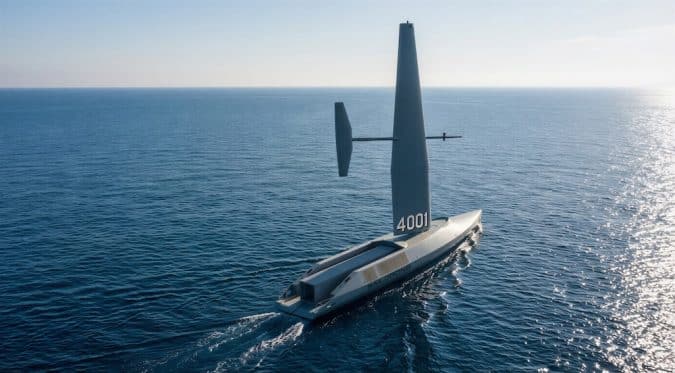
Spectre is Saildrone’s largest and most capable vessel to date—52 meters (170 feet) long, weighing 250 tonnes, and capable of speeds up to 30 knots. It is optimized primarily for anti-submarine warfare (ASW), a mission that demands long endurance and an ultra-quiet acoustic signature.
“Spectre is not a craft hurriedly readied to meet a particular RFP, but diligently evolved over multiple years to meet the operational requirements of our customers and fill critical capability gaps in the ASW domain.”
— Richard Jenkins, Saildrone Founder & CEO
The vessel runs twin shaftlines with dual electric and diesel propulsion. At low speeds, it operates near-silently on electric power up to 12 knots—critical for ASW towed-array operations. When speed is needed, 5,000 horsepower of Caterpillar diesel engines push the vessel to 27 knots with a full payload. At cruising speed, Spectre carries a range of up to 3,280 nautical miles in calm water.
- The concealed payload deck can accommodate up to 70 tonnes of payload—configured as dual 40-foot containers, up to five 20-foot containers, or a mix—positioned close to the waterline for easy transom deployment. The vessel is designed to carry two Mk70 VLS launchers (capable of firing missiles), thin-line towed arrays, and the CAPTAS-4 variable-depth sonar system.
Pensacola’s Role
The 43-meter (140-foot) composite Saildrone Wing—the heart of Spectre’s silent propulsion and endurance system—will be manufactured by American Magic Services at the American Magic High Performance Center in Pensacola. AMS was originally established to serve the America’s Cup racing program and has since expanded into marine, aerospace, and defense composite manufacturing.
“At the American Magic High Performance Center in Pensacola, in close proximity to key US naval and maritime operations, we bring together elite composite manufacturing and a proven high-performance culture, positioning us to deliver at the level this platform demands,” said AMS CEO Tyson Lamond.
A Formidable Team
Saildrone has assembled a defense-industry coalition around Spectre:
- Lockheed Martin — payload integration, including the TB29 thin-line towed array and Mk70 VLS launcher, plus planned live-fire demonstrations
- Fincantieri Marine Group — hull construction at Wisconsin shipyards, with capacity for five vessels per year
- Thales/AAC — CAPTAS-4 variable-depth sonar system
- American Magic Services — composite wing manufacturing, Pensacola
The design has been approved in principle by ABS under the High Speed Naval Craft certification, and performance has been verified through extensive tow-tank testing at Force Technologies in Copenhagen using a 1/7-scale model under conditions up to Sea State 5.
Bottom line: Pensacola’s American Magic High Performance Center—born out of competitive sailing—is now a key manufacturing node for one of the Navy’s most advanced autonomous surface combatants.