EARLY CHILDHOOD
Is 100% Kindergarten Readiness by 2030 an Impossible Goal?
Not for lack of trying in Escambia County, but the math is brutal.
Florida’s Business Alliance for Early Learning has set an ambitious target: every child in the state ready for kindergarten by 2030. The Pensacola Chamber also adopted the same goal in 2022 with its 2030 Pensacola Blueprint.
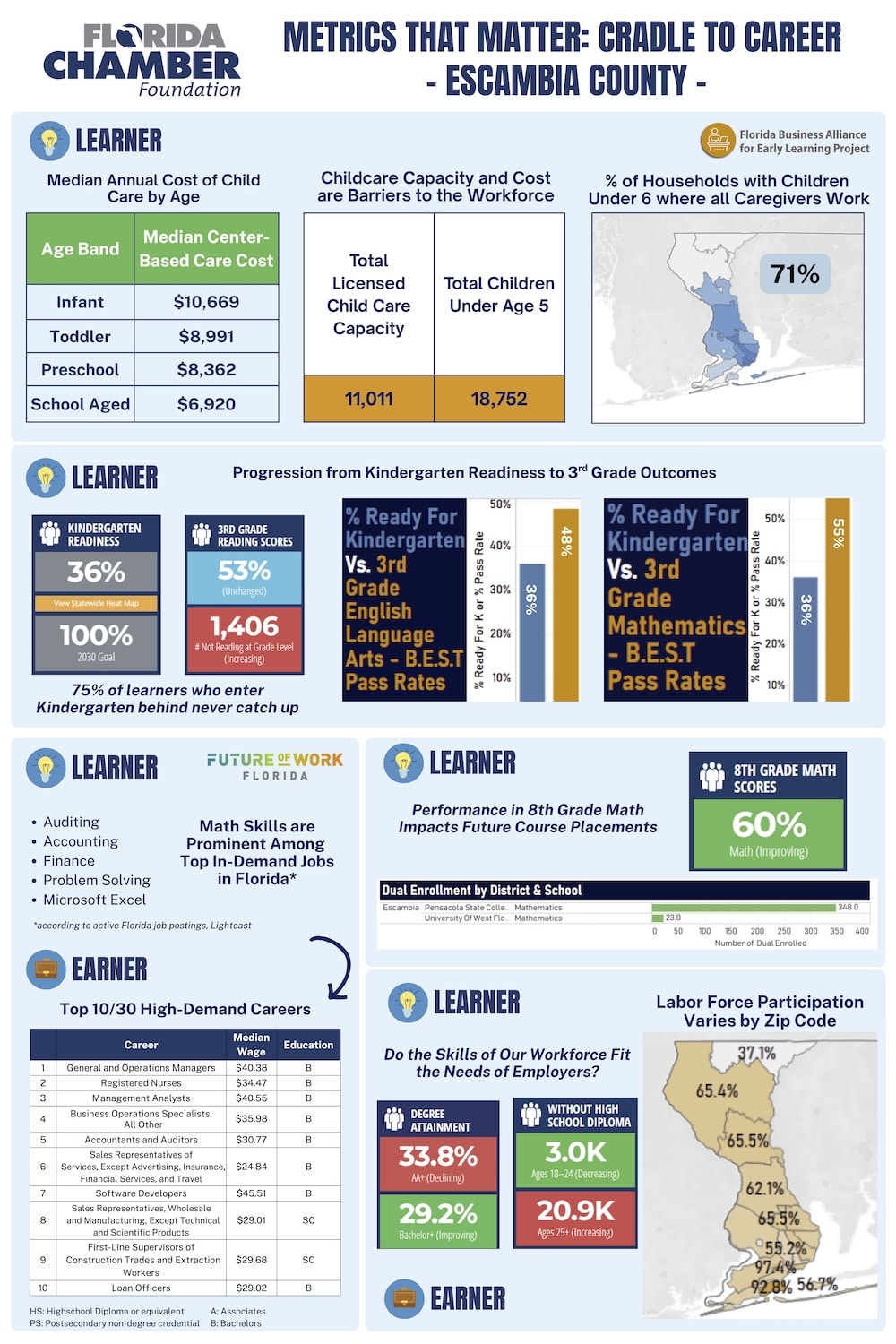
- Halfway to the deadline, the state is nowhere close. In Escambia County, the numbers are worse than nowhere close. We’re moving in the wrong direction, from 48% in 2022 to 36% last year.
The State of Play
The Florida Chamber Foundation’s newly released 2025-2026 Kindergarten Readiness Report puts a hard number on the problem: only 44% of Florida’s public and charter school kindergarteners entered school ready in fall 2025, with access and quality in early learning programs remaining uneven and leaving too many children behind before they even start.
- Three-quarters of Florida children who start kindergarten behind never catch up to their peers, and with 56% of the state’s students starting off-track, the strain shows up throughout the education system, the economy, and the workforce pipeline.
Where you live matters enormously. Readiness rates swing from counties nearing 60% down to others below 20%—a gap the Chamber says points to where targeted investment and cross-sector leadership could do the most good. St. Johns County leads the state at 58%; Jefferson County sits at the bottom at 13%. Read Florida’s 2025–2026 Kindergarten Readiness Report.
Escambia Stuck in the Middle
Escambia County isn’t in the state report’s published top-five or bottom-five lists, but the county-level data from the Florida Department of Health tells its own story.
- Escambia’s kindergarten readiness rate dropped to 36% in 2025, down sharply from 49.5% the year before
- The statewide rate itself slid from 51% to 44% over the same period
- That’s a 13.5-point one-year collapse locally — nearly triple the size of the statewide decline
That local number is exactly why the Escambia Children’s Trust board voted unanimously this month to release its $3.5 million “Bright Beginnings” RFP — the 0-to-age-6 readiness network this blog has been tracking since the RFP dropped July 15. Read Bright Beginnings.
Florida Chamber’s Own Data Argues Against an Easy Fix
The Florida Chamber reports what actually drives readiness, and none of it is quick. Two findings stand out and show that ECT may be on the right track with Bright Beginnings.
- VPK matters, but it’s not sufficient on its own: Children who complete Florida’s Voluntary Prekindergarten program are significantly more likely to be ready for kindergarten than those who don’t participate, but VPK is only one piece of a broader early-learning and family-support landscape.
- Readiness is shaped well before age four by access to quality child care, participation in the School Readiness tuition-assistance program, and family circumstances. Bright Beginnings is built around that broader window with its seven-stage model that starts at conception, not age four.
- The Studer Community Institute’s Building Brains program and Escambia Healthy Start Coalition have been working with mothers, newborns, infants and toddlers for years.
“Today’s kindergarteners are tomorrow’s workforce. If we want to build a top 10 global economy by 2030, we have to start early.” — Mark Wilson, President & CEO, Florida Chamber of Commerce
Poverty is the dominant variable, and it’s a strong one. The Florida Chamber’s own analysis found a strong negative correlation between a county’s childhood poverty rate and its kindergarten readiness rate across all 67 counties. As poverty rises, readiness falls, and only one Florida county where a third or more of children live in poverty manages to get 40% or more of its kids kindergarten-ready.
- Escambia’s child poverty rate sits well above the statewide median, which helps explain both the county’s chronically low readiness numbers and the volatility in the most recent data.
What the Report Says Works
The Florida Chamber isn’t just diagnosing the problem. It points to two in-state models that offer something closer to a playbook, and both echo what ECT is attempting.
Pinellas County has consistently outperformed the state average, and the report credits the Pinellas Early Literacy Initiative, a VPK-through-2nd-grade effort that combines an aligned curriculum, instructional coaching for early educators, and coordinated partnerships between the school district and both public and private VPK providers.
- Its readiness rate climbed from 70% to over 75% in the most recent year measured.
The report also highlights Immokalee, a high-poverty community where the Guadalupe Center’s sustained early-learning investment has produced graduates who overwhelmingly meet or exceed kindergarten standards, proving, the Florida Chamber argues, that concentrated poverty doesn’t have to be destiny if the early-learning infrastructure is strong enough.
Both examples share a structural feature that Bright Beginnings is trying to replicate: a coordinating “backbone” entity that aligns curriculum, funds coaching, and forces disparate providers to act as one network rather than as competitors. ECT’s RFP language about serving as a “backbone entity” for a “centralized network structure” isn’t an accident; it’s borrowed directly from the collective-impact model the Florida Chamber cites as evidence of what actually moves these numbers.
By the numbers: Getting Florida from 44% to 100% readiness by 2030 requires an average gain of roughly 14 points a year. No county in the state sustained that pace even in its best recent year — Pinellas’ widely-praised jump was about 6 points. Getting Escambia from 36% to 100% would require an even steeper climb, from a lower base, after a year that moved backward.
Is 100% by 2030 Realistic?
The Florida Chamber’s own roadmap acknowledges the goal is nearly impossible without saying so directly. Its year-by-year plan doesn’t target 100% until the very last year, 2029-2030, and spends the preceding four years on more modest, sequential goals: closing access gaps, building workforce quality, scaling proven tools, and targeting the worst-performing zip codes.
- The report’s own list of “milestone communities” to celebrate is pegged at 60%, 70%, 80%, and 90%.
None of that means the effort is wasted. ECT has set ambitious metrics for Bright Beginnings:
- 85% enrollment among eligible families,
- 75% of kindergarten entrants meeting readiness benchmarks,
- 90% of families connecting to at least one community resource
If ECT’s providers hit even half of those targets over the three-year contract period beginning December 1, it may achieve one of the sharpest local readiness gains anywhere in the state.
- For Escambia County, coming off a year that erased its gains in one cycle, the question isn’t whether the county hits 100%. It’s whether Bright Beginnings can stop the bleeding.