
Accountability
The Department of Homeland Security’s Office of Inspector General has released its findings on an unannounced January 2026 inspection of the Florida Soft-Sided Facility (FSSF) in Ochopee—the detention center better known by its nickname, “Alligator Alcatraz.” The report, OIG-26-22, is dated Sept. 11, 2026, and it does not paint a flattering picture of how the DeSantis administration ran the facility, or of how much oversight the federal government actually exercised. Read OIG-26-22-Sep26
- Why this matters: Inspectors found Alligator Alcatraz complied with intake and use-of-force standards, but failed to meet standards in six other categories—environmental health and safety, special management units, medical care, food service, personal hygiene, and recreation.
- The facility ceased operations in June 2026, and DHS administratively closed all 10 of OIG’s recommendations as a result.
- But the DHS findings of the state’s inhumane treatment of detainees are shocking.
Background: How “Alligator Alcatraz” Came to Be
The facility traces back to when Gov. Ron DeSantis signed Florida Executive Order 23-03 in the first month of his second term (January 2023). The order declared a state of emergency over illegal immigration and authorized the state to repurpose the Dade-Collier Training and Transition Airport—an 11,000-foot runway deep in the Big Cypress National Preserve, about 50 miles west of Miami—into a detention center.
2025 Construction: The DeSantis administration moved on that authority in June 2025, and crews built the tent-and-fencing complex on the airstrip’s existing concrete in roughly eight days. It opened July 3, 2025, with a contractual capacity of 1,500 and room to grow toward 3,000 beds.
DeSantis has framed the facility as a response to a federal capacity problem, not a state initiative built to punish. Explaining why Florida stepped in, he told reporters that the one thing state officials kept running into was that “DHS did not have the capacity” to hold and process people awaiting deportation. He described the arrangement as a direct ask from Washington: “We had a request from the federal government to create the facility.”
- Florida Attorney General James Uthmeier coined the facility’s nickname, and DeSantis adopted it at that same briefing.
President Trump toured the site on opening day alongside DeSantis and Homeland Security Secretary Kristi Noem, and both men later floated it as a template for the rest of the country.
- DeSantis continued defending the facility as it wound down nine months later, citing cost savings and calling the decision to build it a matter of principle over politics. At an unrelated press conference in Brevard County, he said “We’ve saved taxpayers money” on medical care and schooling for undocumented immigrants, adding that he’d rather do what’s right than what’s popular.
Finding: Nobody Could Say What Rules Applied
Maybe the most damning finding is that FSSF staff couldn’t consistently say which detention standards they were even supposed to be following:
- Some staff told OIG they used a mix of the 2019 National Detention Standards, the Florida Model Jail Standards, and Florida Department of Corrections standards.
- Others said they followed the 2019 standards but were “aiming” for the 2025 version.
- ICE’s own paperwork listing contractually obligated standards for the facility simply said “N/A.”
- The Detainee Handbook told a different story still, citing standards the facility didn’t appear to be using at all.
“It was ‘so gray as to whose place this is…and which standards to follow.'”
— Facility official, quoted in the OIG report
Because of that confusion, OIG applied whichever standard—state or federal—was more restrictive whenever it found a problem. Even by that generous approach, the facility fell well short.
Finding: 28 Square Feet Per Detainee—Less Than Half What’s Required
FSSF housed detainees in eight windowless soft-sided structures, each containing eight metal-mesh housing units. The applicable standard requires at least 75 square feet of floor space per detainee in dormitory-style housing. At maximum capacity, FSSF was giving detainees 28 square feet — well under half the minimum.
By the numbers — Housing Unit occupancy in Pod Alpha 3
- Unit 4: 32 detainees — 28.0 sq. ft. per person
- Units 1 & 2: 31 detainees each — 28.9 sq. ft. per person
- Unit 7 (best-case): 22 detainees — 40.8 sq. ft. per person
- None of the eight units met the 75-square-foot standard
Detainees spent nearly all of their time confined to these units:
- They were allowed out only for three 90-minute meal periods a day,
- an hour of recreation three days a week,
- showers three times a week, and
- medical appointments.
The units had no common areas, seating, tables, or storage—just bunk beds behind metal fencing topped with 9-foot mesh.
Finding: The “Calming Areas”—Small Metal Enclosures Used on 79 Detainees
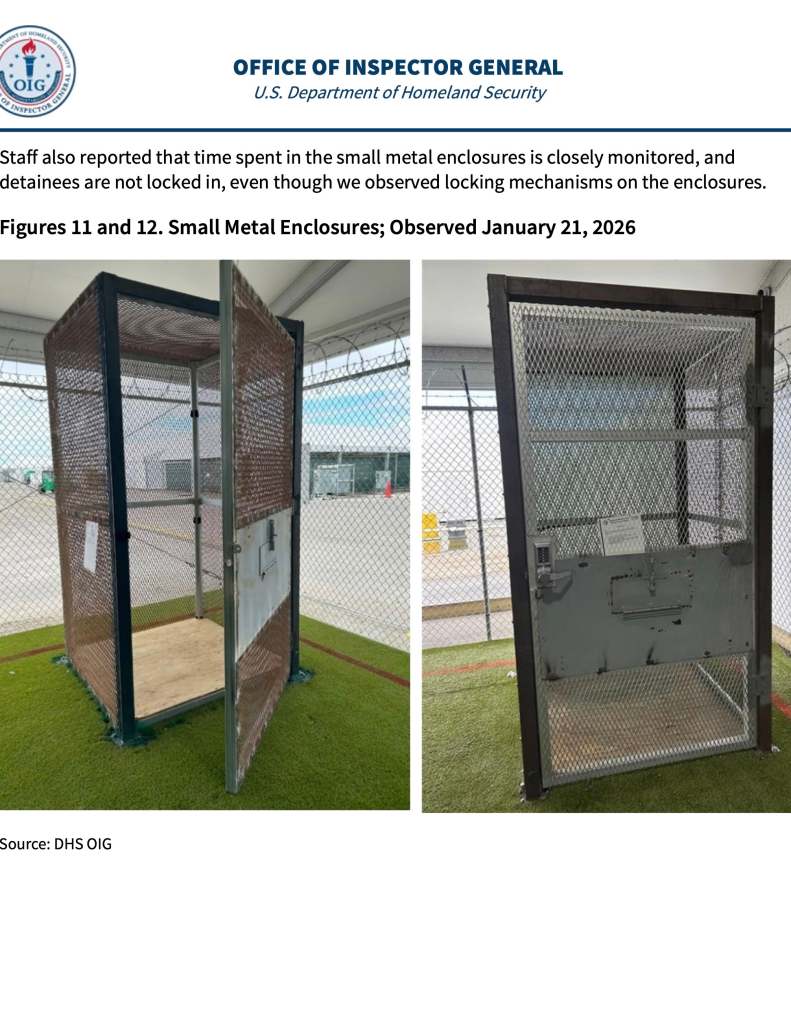
This finding is garnering the most attention in the national media. Between July 17, 2025, and January 18, 2026, FSSF confined 79 detainees in small metal enclosures—roughly 18 square feet of floor space, about 4 feet 3 inches by 4 feet 3 inches—for periods ranging from a few minutes to nearly two hours. The average stay was 59 minutes and 27 seconds. The longest was 1 hour, 59 minutes, and 18 seconds.
- Facility staff called them “calming areas”—spaces where detainees could supposedly de-escalate on their own request. A posted policy described the “Holding Cell Space” as a place for detainees “to reflect on their behavior choices, manage their emotions, reduce stress, and practice self-directed behavior,” with a two-hour cap and water provided on request.
OIG found at least one case that undercuts the voluntary framing: facility records showed a detainee spent 26 minutes in one of the enclosures for having “failed to comply with a lawful command”—language that describes discipline, not a wellness break. Inspectors also noted that although staff insisted detainees weren’t locked inside, the enclosures had visible locking mechanisms.
“Use of these small metal enclosures for any reason is unprecedented among detention facilities OIG has inspected and presents significant risks to detainee health and safety.”
U.S. Senators Jon Ossoff and Dick Durbin had already raised concerns about these enclosures back in March, citing reports of detainees confined in direct sunlight, heat, humidity, and insects, sometimes restrained for hours and denied food or water.
- OIG says it couldn’t independently confirm or refute those specific allegations, since none of the eight detainees its team interviewed on the day of the inspection reported experiencing them. But the underlying practice—small locked metal boxes as a management tool—got no defense from inspectors regardless of how it was used.
Other Findings: Dirty Water, Bug-Infested Showers, and Three Showers a Week
Drinking water: Detainees get individual plastic cups and draw water from shared 5-gallon coolers. Six of the eight detainees OIG interviewed said they did not have access to clean drinking water and described it as dirty. Cups had no dedicated storage. Inspectors found them sitting on floors, bed rails, and bathroom ledges.
Showers: Standards call for daily shower access. FSSF offered showers only on Mondays, Wednesdays, and Fridays. Inspectors also found the shower ceilings infested with small insects. When OIG asked detainees directly whether the facility was clean, seven of eight said no, and two specifically pointed to the showers.
Food service: One freezer, labeled “Freezer #1,” registered 10 degrees Fahrenheit—then 14 degrees 17 minutes later—well above the 0-degree maximum for safely storing perishable food.
Recreation: General population detainees got one hour of recreation, three days a week, against a standard of at least an hour a day, five days a week.
The Special Management Unit: No Working Phones, No Legal Materials
FSSF’s SMU held detainees in administrative or disciplinary segregation in 16 individual 8-by-7-foot cells. Only detainees in protective custody—those who posed no security risk—got access to a general recreation area, for five hours a week. Everyone else in the SMU was confined to their cell except for escorted bathroom trips, legal appointments, or medical visits, with no TV, no cards, and reading material limited to religious texts.
- One detainee in administrative segregation told inspectors he’d been held 8 days without any recreation at all — standards say denial of recreation beyond seven days should be rare and requires sign-off from both the facility administrator and a health professional.
- SMU detainees also had no access to a law library or legal materials, and
- while FSSF had just installed telephones in the unit before the inspection, OIG’s team tested one and confirmed it didn’t work. One detainee said he went the full 8 days in the SMU with no way to call his attorney or his ICE case officer.
Who Was Actually in Charge?
DHS’s formal response to the draft report did not address a single one of the 10 recommendations. Instead, the Department argued that Florida—not DHS—held authority over FSSF’s day-to-day operations, because the state detained people there under its own Section 287(g) delegated authority, not under a direct federal contract.
OIG pushed back on that framing. Its report lays out evidence that ICE had real oversight and presence at the facility even without a contract:
- The Detainee Handbook told detainees FSSF “is a detention facility of the United States Immigration and Customs Enforcement (ICE)” and said it followed ICE’s own PBNDS and American Correctional Association standards
- ICE information posters were posted throughout the facility
- ICE personnel were on-site assisting FSSF staff, and had to escort OIG’s own inspectors in on day one
- DHS and Florida both told federal courts that FSSF operated with ICE oversight under 287(g)
- Florida told a federal court that ICE decides which detainees go to Alligator Alcatraz in the first place, and can recall them at any time
OIG also noted that regardless of who ran daily operations, DHS still controls the federal money. Under FEMA’s Detention Support Grant Program, the agency obligated $608.4 million to Florida’s Division of Emergency Management for FSSF in September 2025, and had disbursed $58.3 million of it by May 2026 for operational costs—staffing, supplies, detainee support services.
Alligator Alcatraz Is Closed. The Same Questions Aren’t.
FSSF shut down in June 2026, which explains why all 10 of OIG’s recommendations were administratively closed rather than tracked for compliance.
But the report closes with a pointed reminder that the same setup persists elsewhere in Florida: the Baker Correctional Institution in Sanderson—nicknamed “Deportation Depot”—is a state-run facility that opened in September 2025 and, as of late August 2026, held 1,028 detainees.
- Just like Alligator Alcatraz, ICE lists Baker’s contractually obligated detention standards as “N/A.” Unlike Alligator Alcatraz, Baker hasn’t been inspected by ICE’s Office of Detention Oversight and isn’t scheduled for inspection in the next two fiscal years.
Bottom line: The facility that generated 79 confinements in metal boxes and a report full of “did not comply” findings is gone. The structure that let it operate with nobody sure who was in charge is still in place…until we get a new governor.