Environment
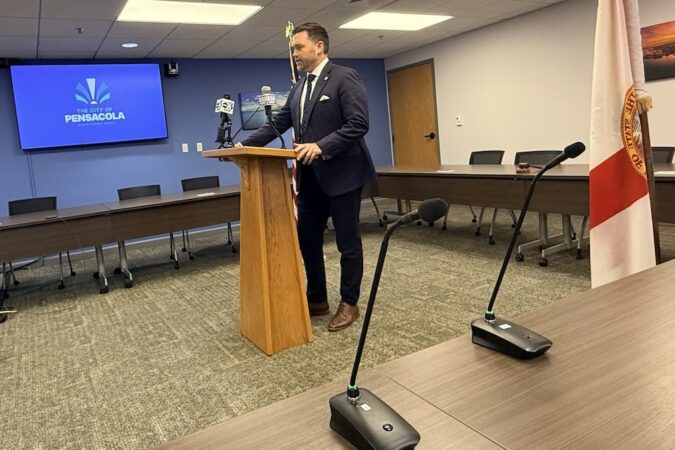
Pensacola has secured more than $50 million in additional federal and state funding for the American Creosote Works (ACW) Superfund site over the past 12 months, Mayor D.C. Reeves announced at his press conference this morning, citing new commitments from the EPA and Florida DEP that fully fund phase one of the cleanup and cover a large share of phase two.
- The update: EPA’s Pete Thorpe told residents at a community meeting Tuesday night that phase one work, primarily residential soil remediation around the main ACW site, will begin in December. That’s later than city officials had initially hoped, but Reeves said the delay reflects the scope of getting the project fully funded.
“Within the last 12 months, we’re over $50 million of additional funding that wasn’t there, thanks to DEP and EPA,” Reeves said.
Background: The 18-acre American Creosote Works Inc. (Pensacola Plant) Superfund site is located on 701 J Street in Pensacola, Florida. It includes the area where a wood-treating facility operated from 1902 to 1981.
Two Phases
Phase one funding gap closed. The city had faced roughly a $9 million shortfall to fully fund phase one. Reeves credited EPA, along with several trips to Washington, D.C., with closing that gap.
Phase two funding largely secured. EPA confirmed Tuesday night that phase two, estimated at $68 million total, now has a cost-share agreement between DEP and EPA covering $48.4 million of that work. Phase two includes:
- Barrier wall construction
- Cap installation
- Thermal extraction remediation activities on the main site
By the numbers
$50M+
in new federal/state funding secured in the past 12 months
$9M — phase one gap now closed
$68M — total estimated cost of phase two
$48.4M — DEP/EPA cost-share commitment toward phase two
What’s still open: The remaining balance of phase two funding, roughly $19.6 million, is not yet secured. Reeves said the city will keep working to close that gap, but the immediate priority is getting phase one underway in December.
- The city’s role. Reeves was careful to note that ACW is a fully federally funded and operated project. “The city has no operational role whatsoever in the day-to-day functioning [or] timeline,” he said. The city’s function is as a participatory third party, helping pursue grant funding and additional dollars where it can.




I recall attending a EPA meeting in Sanders Beach in the summer of 2008. (I was then a mayoral candidate.) I gave a copy of EPA’s “plan” to a friend who gave it to his son a geotechnical engineer. The son assessed that EPA intended to do as little as possible as cheaply as possible. Is the current plan better or just a newer version of the old plan? Leaving even a pound of contaminated soil anywhere on the site seems a very bad idea. I presume the situation today is every bit as bad as it was in 2008. I recall going to Sanders Beach on a hot summer day after a rain storm. You could smell the benzene in the air. A friend pointed out the “film” visible on their car windows. I told them it was in their lungs too! Are people warned when they buy a home in Sanders Beach? They should be.