Escambia County still runs on state rule, not home rule. Unlike the City of Pensacola, which operates under a charter that created a strong-mayor system and let voters set their own rules on elections, salaries and government structure, the county has none of that. The Florida Legislature dictates everything—from commissioner pay to the checks and balances.
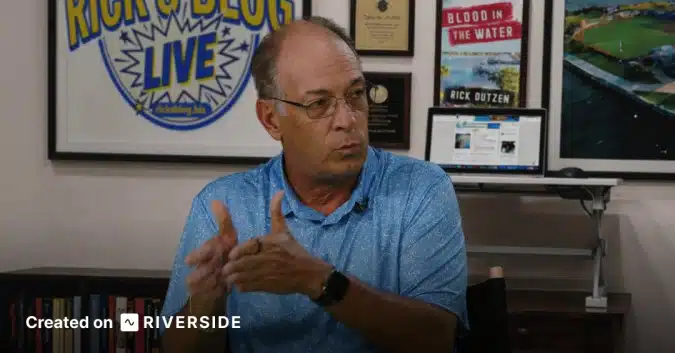
- On the latest episode of Rick’s Blog Live, I sat down with John Peacock, one of the key figures behind Pensacola’s original push for a strong-mayor charter, to make the case that Escambia County is overdue for the same conversation.
Peacock’s core argument: under the current commission system, voters have no way to hold county government accountable as a whole. “You can’t affect change with your vote,” he said. A single commissioner can be excellent and still be outvoted by four others. There’s no one citizens can vote out if they’re unhappy with the county administrator or the pace of economic development—because no one is elected to run the county as a whole.
“We gotta five people that think they’re all county mayors of their own little district, and nobody ever communicates because they can’t—Sunshine Law—and nothing ever really gets done.”
What Peacock Wants in Charter:
- Create an elected executive—a “county mayor”—who citizens can hold directly accountable, similar to the city’s strong-mayor system
- Set local rules on salaries, elections, recall provisions and referendums
- Establish a true executive-legislative structure, with checks and balances written by a local charter commission—not Tallahassee
The charter does not mean consolidating city and county government; Pensacola would keep its own charter and strong mayor, and the county would simply get its own
How: Peacock pointed to two paths to get there: a petition drive requiring signatures from 15% of the electorate, or the County Commission voting to appoint a charter study committee of 11 to 15 members under state statute. Either way, any resulting charter would go before voters for final approval.
Near Miss in 1995
In June 1995, Escambia County voted down a county charter by just 56 votes: For 15,679; Against 15,735. City voters like the idea, with 21 of 37 precincts supporting the charter. However, those outside the city limits strongly opposed it, with 60 of 99 precinct voting against the charter.
The county had two camps—Citizens for Home Rule and Dump the Charter. The strongest argument against the charter was it gave too much power to the commissioners.
- The charter would have kept the tax collector, property appraiser, sheriff, supervisor of elections, and clerk of court as elected offices, but they would be charter officials, not constitutional officers. The charter would have forced constitutional officers to consolidate some purchasing, legal, and computer services and develop an administrative code.
Escambia County tax collector Matt Langley Bell III served as the treasurer of Dump the Charter Committee, and he had allowed all of his employees to wear anti-charter T-shirts on the job.
- Opponents framed their victory as people winning over big government, big business, and big money. Citizens for Home Rule Charter raised $26,932, mostly from business, real estate, banking, and legal interests. Dump the Charter raised $3,706, mostly in individual contributions.
Two Earlier Attempts: Escambia County voters also rejected a charter in 1977, with a vote of 8,575 to 6,981. Opponents argued that the county charter would lead to consolidated government. The Charter Commission added a prohibition of consolidation as the second section of the draft charter but it didn’t deter the criticism. The 1977 Charter as published as public notice in the Pensacola News Journal on 10/03/1977: Page 1; Page 2; Page 3.
- In 1979, The proposed charter would have added two countywide elected commissioners, increasing the board to seven members. The county commission races would be nonpartisan. The 1979 referendum failed 15,265 to 13,376.
2004 Blowout
On March 9, 2004, Escambia County voters soundly defeated a charter initiative by more than 10,000 votes—the largest margin of defeat among all the attempts at a charter—61% cast “no” ballots, and 39% voted “yes.”
- The charter government would have doubled the commission’s size, expanding from five to 10 members. Commissioner salaries would have been cut from $68,000 annually to $34,000. Under charter government, county residents would have gained the power to recall county commissioners.
Again, the charter issue pitted city residents as charter supporters against county residents who were staunch opponents. Voters in the western and eastern areas of the county turned out in large numbers to defeat the proposal.
Why? Fear of higher taxes.
Other Concerns:
- The non-interference clause would have prevented county commissioners from directing rank-and-file county employees to perform work in their districts. Residents in the north end of the county were concerned that this clause would prohibit commissioners being able to follow up on constituent service requests.
- A seven-vote supermajority to fire the county administrator also resonated with voters who were fearful that the charter would create a super county administrator.






Linda, we are very early in the process. The pro-charter folks need to get on the county commission’s agenda and receive three votes to establish a charter study group. Or they can go the petition route. Either way, the details will be critical to garnering public support. The charter must appeal to more than just city residents.
I hope that Rick Outzen will also have a person that feels strongly against the Charter issue on his blog. Mr. Peacock is pro charter and presents pro ideas. In order to make an informed decision, I think people need to hear both sides equally without ranker or exaggerating claims. Make a list of truthful pros and cons and a list of questions and answers from the public. Publicize that information in as many media areas as possible. Voting for something or someone is ineffective if people just vote to be able to say “I voted”. If they aren’t truthfully informed about what they’re voting for, voting is useless.
Florida has 67 counties with 20 charter counties having 75% of the state’s population. Florida’s “Optional County Charter Law” describes the process for converting a non-charter county (there are 47) to a charter county. (It does not appear to describe a 15% petition process. More details in future reporting please.) The four counties in Northwest Florida (Escambia County, Santa Rosa County, Okaloosa County and Walton County) are all “non-charter” counties. Three work great. One (Escambia County) is a mess. Does Peacock propose that all four counties transition to become “charter” counties or only Escambia? If Peacock only wants to change Escambia County, why? Peacock’s long-standing gripe going back to 2008, when he first briefed me on his personal ambition to become the county’s autocratic “strong mayor” has remained, “You can’t affect change with your vote.” One easier way to “affect change” in Escambia County would be for someone to file to run for a seat on the Escambia County Commission, Escambia County Public Schools Board or Emerald Coast Utilities Authority Board and then file a lawsuit asking the Court to declare as unconstitutional the gerrymandered election districts used by all three bodies, the product of secret meetings handpicking voters and trading blocks of Black and White voters back and forth. During a November 2021 workshop, Commissioners Bergosh and May very openly discussed trading blocks of Black and White voters to help bump up the number of Black voters in District 3. (It reminds me of how in 2011 Councilman Larry Johnson testified before the city’s Districting (“Gerrymandering”) Commission led by DeeDee Davis expressing his concern about “the racial mix” in his District 4, leading to a lower percentage of Black voters.) At the November 2021 workshop, County Attorney Alison Rogers did tell the BCC that the McMillan federal court ruling had expired, presumably decades ago. But no one openly asked her when it had expired or what that meant. I later asked her in private. She said she didn’t know and didn’t seem interested in finding out. I politely suggested that what happens when a federal court order expires is likely governed by the Federal Rules of Civil Procedure. My theory was that when the McMillan court order expired the county election process should have defaulted back to at-large elections. Commissioner Kohler now seems the one elected official in the best position with some credibility to raise this issue. He should ask the new County Attorney Mr. Nelson to research the issue and report back to the BCC. (I bet county files do include some relevant documents.) If after we’ve returned to countywide at-large elections things are still bad then perhaps we can begin to discuss the concept of a charter government.
I believe it’s time for folks in our area to become truly vested in the governance of our area…. Perhaps this could become a “ louder voice” with reasonable and appropriate changes ahead!
In Escambia County you have a few real levers — voting is only one of them:
*1. On the record — where they have to answer:*
– *County meetings:* They meet Thursdays at 221 Palafox Place. You get 3 minutes for public comment. It’s on video and in the minutes, so it creates a record.
– *Public Records Request:* Florida Sunshine Law is strong. You can email Clerk@EscambiaCounty.com or use their portal and request emails, texts, calendars, or contracts for any commissioner. Just say “Pursuant to Chapter 119, F.S., I request…”
*2. Formal complaints:*
– *Florida Commission on Ethics:* If it’s a conflict of interest, misuse of office, or financial disclosure issue — File online at http://ethics.state.fl.us. That’s the one with teeth for county commissioners.
– *Florida Attorney General / State Attorney (1st Judicial Circuit):* For Sunshine Law violations — meetings held in secret, or refusing records.
– *Escambia County Clerk & Comptroller:* They audit spending. You can ask for an audit inquiry.
*3. Political accountability:*
Florida does *not* have recall for county commissioners. Removal is only by:
– Governor suspension (for malfeasance, felony, etc.)
– Next election
– Court action
So the most effective pressure is usually a combination — show up, get the records, and put it in writing to Ethics if you see a specific statute violated.